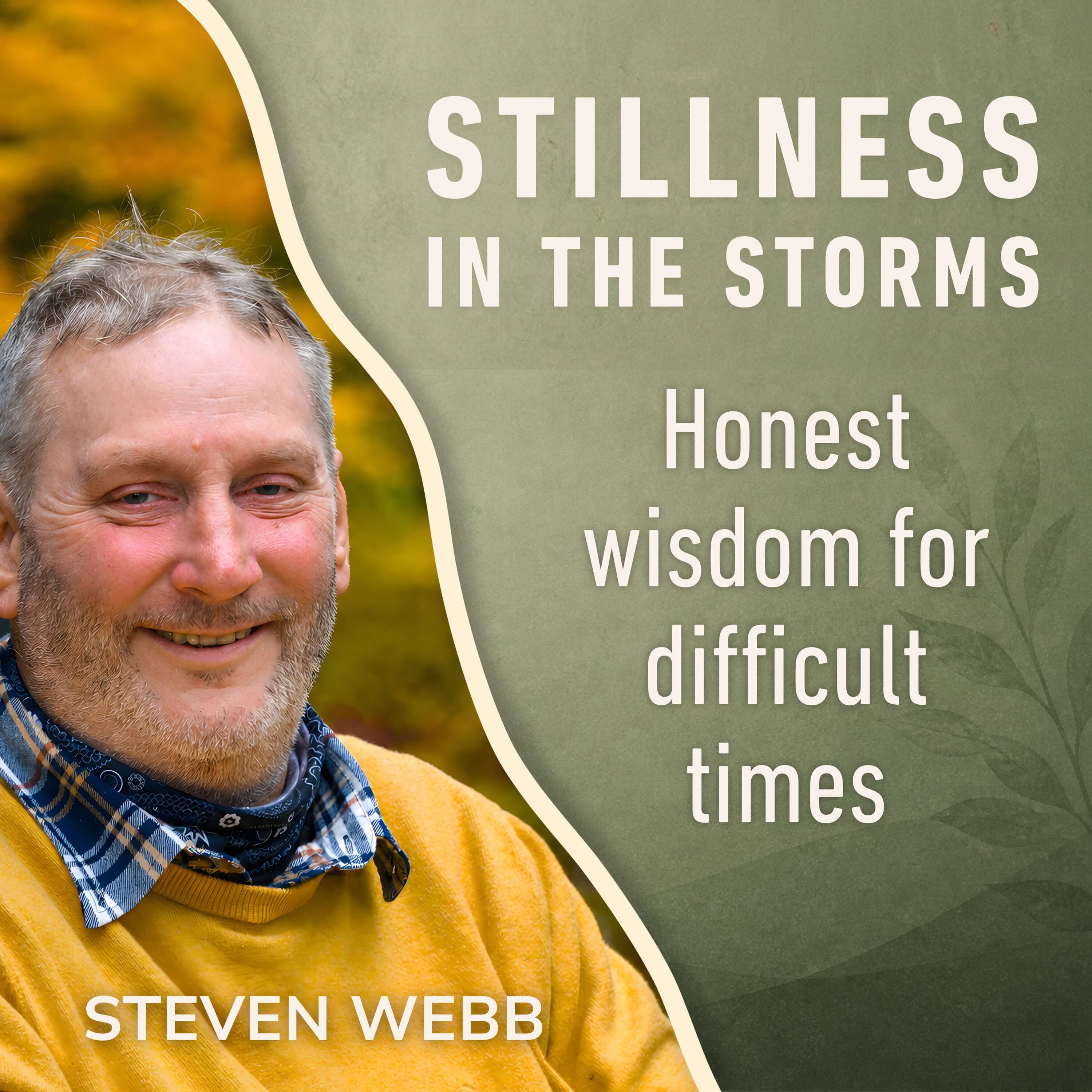

Episode 4
Can Over Thinkers Meditate?
Can an overthinker actually meditate? I could not for twenty years, because I thought meditation meant no thinking. It does not, and that changed everything.
At 40 I hit rock bottom, could not sleep, and every book I picked up told me to meditate. I was diagnosed dyslexic so I had stopped bothering with books, then started again because reading was the only thing getting me to sleep. Your mind is built to think the way your heart is built to pump. Meditation is not the absence of thought. It is the gap between the text arriving and your reply.
One thing to try: Notice one gap today. Between somebody speaking and you answering. That is the whole practice.
In this episode
- (0:00) Why meditation comes up this early in the podcast
- (1:30) Is your mind one of the busy ones?
- (2:54) Rock bottom at 40, and not being able to sleep
- (4:30) Reading myself to sleep, having given up on books
- (5:54) Diagnosed dyslexic, so why bother reading at all
- (7:33) Every book said meditate, and I put every one down
- (10:02) Your heart pumps, your mind thinks. That is the job
- (13:17) The gap between the text arriving and your reply
Support the podcast and join the Weekly Calm: stevenwebb.uk
Thank you for listening.
Steven
Links to Steven Webb's podcast and how you can support his work.
- Donate paypal.me/stevenwebb or Coffee stevenwebb.uk
- Steven's courses, podcasts and links: stevenwebb.uk
Transcript
Hello and welcome to my podcast. I'm Steven Webb and this is Stillness in the Storms of Light. It's the
Steven Webb:podcast that will help you have a little inner peace when you have it least and you need it most.
Steven Webb:On today's show, I'm going to help you to get the benefits of meditation, even if you're somebody that cannot
Steven Webb:shut off your mind.
Steven Webb:How does that sound? But today, first of all, let's have a word from my sponsors.
Steven Webb:Okay, I haven't got no sponsors yet. But if you would like to sponsor the show, if you would like
Steven Webb:me to give you a shout out, head over to stevenspodcast.com and you can support me on Patreon and then
Steven Webb:I will give you a shout out on the show. If you're a business or you know a business or
Steven Webb:somebody that really wants to support and help the show grow so I can reach more people, help more people
Steven Webb:have a little little more inner peace. They almost said have a little less inner peace. If you can support
Steven Webb:the show in any way like that, head over to my stevenspodcast.com and you'll see a link to the Patreon
Steven Webb:site in which you, but not only that, you get videos. Like right now I'm recording the video of this
Steven Webb:and you'll see, and it's very much uncut the video, which makes it a lot better. A lot more
Steven Webb:entertaining. So you see me, yeah, I was going to say doing all sorts of things. Probably just scratching my
Steven Webb:nose, to be quite honest. It's one of those things.
Steven Webb:But on today's show, why did I start meditating? Let's start with that, because it'll make sense.
Steven Webb:Are you somebody that has got a really active mind, and your mind goes completely
Steven Webb:blank when you don't need it to at the worst times like recording a podcast? On the other hand, does
Steven Webb:your mind have... Constant overthinking when you want it to go blank a little bit. Like when you're trying to
Steven Webb:go sleep or when you try to focus on something or you're listening to a really important podcast or
Steven Webb:film but you're tired and your mind's like just I can't listen anymore. My
Steven Webb:neurosynapsis is just saying enough. And then you get the idea that I'm going to sit down and meditate for
Steven Webb:like 10 minutes. And there you go. Boom. Your mind goes into overactive mode straight away.
Steven Webb:Well, I started meditating first in my late 20s. But it lasted about four
Steven Webb:minutes, I believe. I started meditating for the wrong reasons. I thought it would be cool and I thought it
Steven Webb:would might even get me a girlfriend or... Get me laid. Sorry to admit that on, you know, we were
Steven Webb:all young once. But then when I turned 40, I hit rock bottom and I found myself in a position
Steven Webb:where I could not sleep. I found myself single and my mind, the only thing my mind would do for
Steven Webb:a long, long time was to go over the questions I had for my ex. I was mad. If I
Steven Webb:settled down for just 30 seconds, it would go like, what are they doing now? What's happening? What are they
Steven Webb:up to? Why did they do that to you? How dare they do that? And it would go to the
Steven Webb:most craziest times of thinking, which is completely irrelevant. But it gave me no peace whatsoever.
Steven Webb:And this is what, I started reading books a few weeks later because I couldn't sleep. So I had to
Steven Webb:almost mask my voice. I had to mask the thoughts in my head. And the only way I could do
Steven Webb:that was to keep my mind busier doing something else.
Steven Webb:Alcohol did not work. I drank for about two weeks and after about four days I doubled the amount.
Steven Webb:Then about another four days, I doubled the amount again. Got a little bit embarrassing because I have carers because
Steven Webb:I'm paralysed from just below the neck. And asking the carers to pull me up drinks every night
Steven Webb:is a little embarrassing. Although they would do it graciously, I'm sure they had plenty on their minds when they
Steven Webb:did it. So after about two weeks of drinking more and more just to get to sleep for two hours.
Steven Webb:Because it never kept me asleep for the night. It was always it was always broken sleep and it was
Steven Webb:never great. I never felt refreshed in the morning. I had to find another way to go sleep. And that
Steven Webb:other way was reading books. I I never really read books because...
Steven Webb:Can you ever remember when you're at school when the teacher used to write on the blackboard for start at
Steven Webb:the top and they used to write the lines out and you And she would say, well, can you copy
Steven Webb:these down? No problem. And I'd be okay, I'd start copying them down. And then of course she would get
Steven Webb:to the bottom of the blackboard and then start rubbing it off from the top as she was going down.
Steven Webb:And I was like, oh my god you're rubbing out what I'm... I still haven't got there yet. I couldn't
Steven Webb:read like a sentence off the blackboard and then write the sentence down. I was doing it one word at
Steven Webb:a time because I couldn't hold the information very easily. So I used to get in trouble for not copying
Steven Webb:it down properly and skipping words and And I just gave up in the end when she got to the
Steven Webb:part of the blackboard that she was rubbing out what I was writing. I didn't want to put my hand
Steven Webb:up and admit that I couldn't copy off a blackboard in front of everybody in the class. So I just
Steven Webb:labbed it and got in trouble most of the time. Got low grades because I didn't copy it down.
Steven Webb:So therefore, at that point, I was diagnosed dyslexic.
Steven Webb:Because I was diagnosed dyslexic, I didn't really bother reading. I got a problem. I cannot read. So why bother
Steven Webb:doing it? Made sense to me. All during my school and sixth form, I blagged it. If we had to
Steven Webb:read a book, I can remember reading Of Mice, Of Men. I can remember we had an English session that
Steven Webb:we had to go through it. Well, I would just have a chat casually to my friends in the queue.
Steven Webb:So what did you think of the book? And I would ask them questions and I would discuss it. To
Steven Webb:give me enough to give me enough that if I was picked on, I could say something. I got the
Steven Webb:gist of the story, which is fine so
Steven Webb:that So then fast forward to 40 years old, rock bottom, drinking to go to sleep. I had to find
Steven Webb:another way. And reading was the perfect thing, simply because I had to focus. I picked up,
Steven Webb:I found a free book on my iPad, As a Man Thinker. It was written over a hundred years ago
Steven Webb:by James Allen, just up the road from me actually. Not only did the book change my life in the
Steven Webb:way I think, but it also took me weeks to read it. And it was only like 40 pages long.
Steven Webb:It took me ages because every paragraph I had to read again and again and again
Steven Webb:would put me to sleep every night, which was ideal. You know, that's what I wanted. So
Steven Webb:then I started reading more and more books. Every single book that I read had one theme. I would turn
Steven Webb:a page and it would say, you need to meditate. And every time it said I needed to meditate, I
Steven Webb:would either put that book away or be really annoyed or something because not me, I think too much. I
Steven Webb:cannot meditate. My mind goes into overtime the minute I sit still. Impossible for me. I'm
Steven Webb:just one of those intellectual type of people.
Steven Webb:That's where I was wrong because at that point I thought meditating was about no thinking and
Steven Webb:it's not. It's not about no thinking at all. Meditation is about controlling your thoughts, becoming
Steven Webb:a master of your thoughts instead of your thoughts controlling you.
Steven Webb:So how do we do that? And what is the point in that? Are we really? Are our thoughts separate
Steven Webb:to us? Can we really control our thoughts? Especially if the thoughts are us, can we control them? So these
Steven Webb:were the kind of questions that went through my mind immediately. So I started to sit down and meditate. And
Steven Webb:it really did not go well for weeks, really. I started with five minutes here, five minutes there.
Steven Webb:And then I read it again in a book and I would try it again. And my typical meditation was,
Steven Webb:okay, I'm going to do it this time I'm going to I'm It's going to be a perfect, brilliant meditation.
Steven Webb:Okay, Deep breath in. Place my arms down beside me and relax.
Steven Webb:Okay, why don't you check Facebook? No, I'm meditating I'll go and check your email. I'm sure you've got that
Steven Webb:email to reply to. No, I'm meditating. Just just send that text. If you send that text, you can meditate
Steven Webb:afterwards. And then suddenly within like within like 30 seconds, you're thinking of such irrelevant things.
Steven Webb:It almost makes it impossible to sit there and have some calmness do you experience Is that what you experience?
Steven Webb:You know, the first time you sat down and meditated, doesn't your mind go up onto thinking? Well, guess what?
Steven Webb:That's what the mind is designed to do, is to think. Just like your foot is designed to do, well,
Steven Webb:be a foot. Apart from stand on it, I'm not sure what a foot's there for. But your heart's designed
Steven Webb:to pump the blood around your body. It's designed to have intuitive feelings. That's why it's got
Steven Webb:neurons around your heart, they found. Just the same as in your brain, they're in your heart. Your liver is
Steven Webb:designed to filter your blood and stuff. I'm not a biologist, but I get the gist of some of the
Steven Webb:stuff. Your kidneys are designed to filter the drinks and all that that you have.
Steven Webb:And asking your kidneys or your liver or your heart not to do their job would be like dying. You
Steven Webb:know, okay heart, don't beat for three, four minutes. It's not good no Not good in any
Steven Webb:way. So, but we're doing the same thing. We're asking our brain to do that same thing, right?
Steven Webb:Please brain, don't think for the next 15 minutes. Well, that's not going to happen. Now
Steven Webb:we have little gaps between thought when the brain's probably thinking some other stuff up.
Steven Webb:We have little moments of blankness. And I could give you one now
Steven Webb:to Sit there just for a moment and I want you to think of your next thought that's coming. Right
Steven Webb:now, think what your next thought is.
Steven Webb:Pretty impressive, right? No thought. You cannot think of your next thought until your next thoughts generated.
Steven Webb:It doesn't exist until... So you have that moment of blankness. But we often want that complete
Steven Webb:blankness for like 15-20 minutes. Well, that's asleep. If
Steven Webb:you've got no thinking, that means you are asleep.
Steven Webb:Make sense? But we don't want to be asleep. That's not the idea of meditating. That's not the idea of
Steven Webb:inner peace. So what is meditation then if it's not about no thinking? If
Steven Webb:it's not about having a blank mind and complete like, ah, for 20 minutes, half an hour, what is it
Steven Webb:about?
Steven Webb:Well, meditation is like the gym for your everyday life. You want more peace
Steven Webb:and you want more tranquility and in your everyday life. How do you get it there? Well you got to
Steven Webb:practice.
Steven Webb:You've got to practice the not reacting, not going to your habitable behaviour. And your
Steven Webb:brain will jump to the habitable behaviour every single time. You see, when something arises, your brain will jump straight
Steven Webb:to that habitable behaviour.
Steven Webb:And it happens so quick that most of the time we don't even catch it. That's why we end up
Steven Webb:snapping or we end up shouting or running out or sending the text that we really shouldn't send.
Steven Webb:We've all done it, and I know you've done it.
Steven Webb:So, the meditation is about creating that little gap between receiving that text and your reply.
Steven Webb:So, how do we do it? Right. It's all about not only what arises on the outside, but what arises
Steven Webb:on the inside and what we do with it.
Steven Webb:So how does meditation help that? Well,
Steven Webb:we sit down on the cushion or on the side of the bed or lying in bed or whatever we're
Steven Webb:doing. We could be waiting for the train or walking in the woods, walking to work or driving the car.
Steven Webb:And what you're doing is you've been aware of your thoughts. So we bring our attention to our breathing. It's
Steven Webb:like right now you could do this with Take a deep breath in, hold it and then breathe out slowly.
Steven Webb:During that process, you had very little thinking. Well, that's not true. You were thinking,
Steven Webb:but you were thinking about your breath. Yeah. So it's about concentration focus and what are we going to focus
Steven Webb:on.
Steven Webb:Now, the breath is the easy one because we've always got that. If you haven't got your breath, there's a
Steven Webb:problem. But no matter what's happening, there's always oxygen in and out your lungs. And you're
Steven Webb:semi part of that. It is automatic with a little bit of input from you. So that's the
Steven Webb:perfect way in which we can jump straight into a meditation. And you could do that hundreds of times a
Steven Webb:day, just like I'm going to do one meditative breath.
Steven Webb:I breathe in, pause, and I breathe out really
Steven Webb:And that's one meditative breath. Now go and take 90 of them. That's meditated
Steven Webb:But the problem is... Our mind will wander. We normally run into story or we run into
Steven Webb:old habits. We run into images in our minds and all kinds of things, future
Steven Webb:things and making up our imagination. That's what we mean by jumping out of meditation, jumping
Steven Webb:out of the mindful moment that is right here now.
Steven Webb:We could use something else. We can use sound, which is the one I use most of the time.
Steven Webb:And part of the Mondo Zen process, one of the questions in that, which I'll put a link to below,
Steven Webb:is that the first question, first Cohen,
Steven Webb:which is like an introspective question that you have to look for the answer and come
Steven Webb:up with it yourself.
Steven Webb:The first question is, can you listen without judgement and without opinion or
Steven Webb:belief?
Steven Webb:So try it.
Steven Webb:So try that for the moment now.
Steven Webb:Can you listen to the noise coming from outside, to my voice?
Steven Webb:Can you listen to whatever is coming in your mind as sound? Can you just allow it to come in
Steven Webb:without forming an opinion of what it is, where it's coming from, whether it's good or whether it's bad? Can
Steven Webb:you just allow it to happen?
Steven Webb:It's interesting because that's meditating. That's what you're doing. And the second part of the meditating
Steven Webb:is the bringing it back. It's realising when you're when you go away. You know, you don't have to be
Steven Webb:down on the cushion You don't have to put your legs above your head in some yogic pose that just
Steven Webb:is wrong. The whole idea is that you pain your mind to recognise when you're not being
Steven Webb:present and to bring it home. Bringing
Steven Webb:it home to the current moment. So like, When I'm doing this podcast, every now and again my mind will
Steven Webb:wander off to perhaps something to eat or perhaps something I'm doing later or what was that noise and I
Steven Webb:get distracted.
Steven Webb:Now then I can either go with that noise, go with that thread, or I can go oh there was
Steven Webb:the thought that was outside what I'm focusing on right now and bring it back. And it's the same when
Steven Webb:you're meditating. If you sit there and meditate.
Steven Webb:You might think about that you've got to check your phone or that you've got to do something that day.
Steven Webb:A favourite of my mind is to do my to-do list. Oh great, you're gonna sit and do nothing. Let's
Steven Webb:do your to-do list all day. Let's work out everything you haven't done and everything you need to do for
Steven Webb:the next 20 years. It happens most days unless unless you want it to happen then it won't happen.
Steven Webb:I thought about that this morning on my meditation. I thought, okay, let's, for the first five minutes, let's go
Steven Webb:through what I need to do today. And it just did not happen. It's funny. That's that's your subconscious mind.
Steven Webb:It's like that sometimes
Steven Webb:it's got It's got a mind of its own. It's not your mind um which is interesting. We'll talk about
Steven Webb:that on future episodes. So how do you bring it back? So why and how do you bring it back
Steven Webb:when you do find yourself distracted into story? Well, you bring it back because the more
Steven Webb:you train your mind to be present in the current moment, the more we can respond rather than react. You
Steven Webb:know, when something goes wrong, we can, if we're present and we're here right now, we can look at the
Steven Webb:situation and go, okay, let's look at what's happening here now and let's respond in the best way possible. If
Steven Webb:we're not present, we go ah what's just happened? Oh my God, panic. Not saying I don't ever panic anymore,
Steven Webb:but I panic a lot less than I used to. It's because I wasn't in control at that point. So
Steven Webb:it's all about gaining control of our mind. It's all about not allowing our mind to control us. So how
Steven Webb:do we bring it back? I've told you why we do it. We bring it back by just smile and
Steven Webb:bring it back. Just the same as a puppy. If you're trying to get it to stay in a certain
Steven Webb:place, you pick it up and put it back. You don't get mad. You don't get angry. Just pick it
Steven Webb:up and put it back again and again. That's what we do in meditation. So if you're concentrating on your
Steven Webb:breaths like I'm breathing in,
Steven Webb:I'm breathing out,
Steven Webb:I'm breathing in. So if you're if that is your meditation or sound or focusing on emotions
Steven Webb:or whatever you want to focus the concentration on, it could be a spot on the wall.
Steven Webb:Every time you recognise that you're not thinking about that, you're not concentrated, Concentrating on that.
Steven Webb:Just smile and bring it back and go, thank you for the thought, but we're going to concentrate on this
Steven Webb:spot on the wall or the breathing or whatever you choose to focus on. And this is the same for
Steven Webb:over thinkers intellectual people. This is the same for you if you think you cannot stop your thinking.
Steven Webb:I
Steven Webb:tell you, you cannot stop your thinking. It's
Steven Webb:impossible. So
Steven Webb:we've got to learn to tame it.
Steven Webb:It's like a puppy. You're not going to stop the puppy wanted to run around.
Steven Webb:So at certain times, you'll be like, okay, I've let you run around for the last little bit. Now we're
Steven Webb:going to come back and be a little more calm.
Steven Webb:And you teach it the times it can.
Steven Webb:Have an imagination and go with it. Because there is times when you need to. And
Steven Webb:there's other times when it's not appropriate to go with it. You don't need to go with it. And it
Steven Webb:might even make things worse if you do. And
Steven Webb:then you just return it to the breath or the spot on the wall or whatever you're choosing to focus
Steven Webb:on during this meditation.
Steven Webb:So you can meditate even if you overthink because I was one of them. I really,
Steven Webb:really was. And I'm not just saying that as some marketer. You know, you have these marketing videos. Trying to
Steven Webb:sell you something. Well, I'm not trying to sell you meditation. I'll tell you all the benefits and say it's
Steven Webb:incredible. It'll make you healthier or lower your blood pressure. It will stop you regretting things. It will make you
Steven Webb:feel better. You'll have more inner peace. You'll have more healthier control over your life. I could list all the
Steven Webb:benefits all day. I invite you to sit down and ask yourself one question.
Steven Webb:Is it possible to purely listen without opinion and belief
Steven Webb:And Just do that for a couple of minutes, a couple of times day That alone you'll start seeing the
Steven Webb:benefits and changes.
Steven Webb:Now next week we will expand on this and I'm going to go through the 10 myths of meditation. This
Steven Webb:is kind of one of them about the thing I'm going to go through the 10 myths of meditation in
Steven Webb:next week's podcast. Because why am I tackling meditation so early on in my podcast? Well because it's really,
Steven Webb:really important.
Steven Webb:And I'm not talking about asking you or inviting you to sit in a cave for three years. You know,
Steven Webb:if you want to go and do that, please be my guest. Invite me along at least like a couple
Steven Webb:of days a week. I would love to sit with you. But that's not what I'm asking you to do.
Steven Webb:I'm asking you to open your mind and open your heart to the possibility that you can
Steven Webb:meditate. And it's not what you thought it was.
Steven Webb:So I'm Steven Webb, an Inner Peace Mentor and I help you to get a little more inner peace in
Steven Webb:life. When you have it least and you need it most. You've been listening to Stillness in the Storms.
Steven Webb:And if you can hit the subscribe button so you do not miss any more episode And if you would
Steven Webb:like to support, that would be amazing and you'll get a shout out on my next show. Just head to
Steven Webb:stevenspodcast.com and it'll take you to a page where you can listen on your favourite platform.
Steven Webb:And you can go to Patreon and support me, which would be absolutely incredible and amazing. And thank
Steven Webb:you.
Steven Webb:Take care. Love deeply. Namaste.