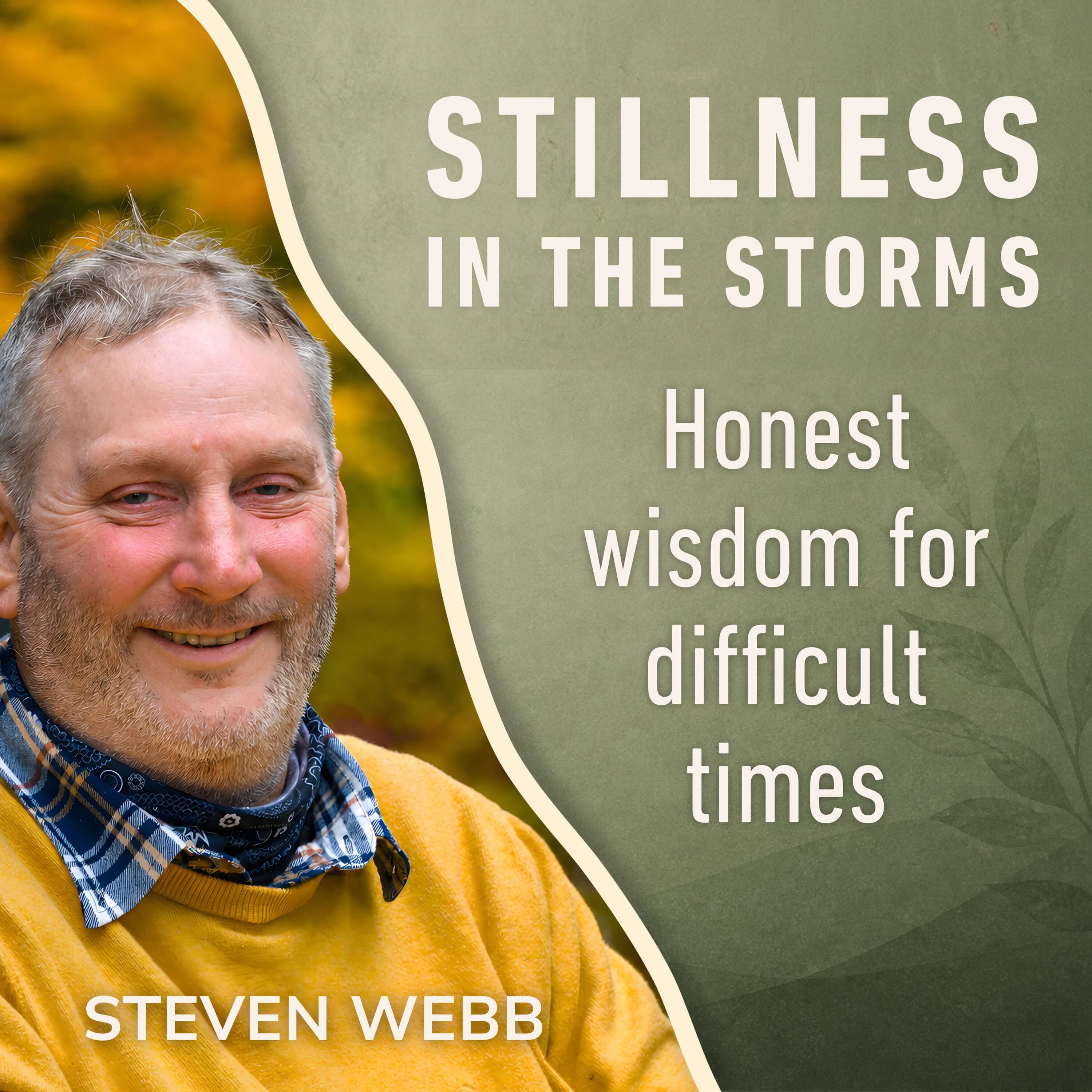

Episode 95
Making Friends with the Present: A Life-Changing Shift
Do you actually know that the worst thing that happened to you was bad? You never know what worse luck your bad luck saved you from.
At 10:31pm I dived in, hit the bottom of the pool and broke my neck. People tell me what my life would have been. A family, a job, the lot. They do not know. Nor do I. When Edison's lab burned down his son found him watching it, and the legend says he was glad, because all his mistakes had burned up with it. Maybe the traffic jam is the reason you are not the accident. You do not know. That is not a consolation prize, that is the actual truth.
One thing to try: Take the hardest thing you have been through and list what it gave you. Strength counts.
In this episode
- (3:12) 10:31pm, the pool, and the sound of it
- (4:04) What people think my life would have been
- (5:28) Some days it is just the carer running late
- (6:34) The child who wanted the green one
- (7:31) Maybe you were not in the traffic jam. Maybe you were the traffic jam
- (10:12) Edison's lab on fire
- (11:30) All our mistakes burned up. We can start again
- (16:48) Coming up the hill and feeling the cold on my face
- (20:15) List the gifts. Then tell me what you got
Support the podcast and join the Weekly Calm: stevenwebb.uk
Thank you for listening.
Steven
Links to Steven Webb's podcast and how you can support his work.
- Donate paypal.me/stevenwebb or Coffee stevenwebb.uk
- Steven's courses, podcasts and links: stevenwebb.uk
Transcript
Welcome to Stillness in the Storms. I'm Steven Webb, your host. And one of my quotes that I always go
Steven Webb:back to and I absolutely love, and this is going to be the subject of this week's podcast, is you
Steven Webb:never know what worse luck your bad luck has saved you from.
Steven Webb:You never know what worse luck your bad luck has saved you from. Cormac McCarthy. No country for old men.
Steven Webb:So this week's podcast is about making friends with the present moment. A life-changing shift and when you really grasp
Steven Webb:this concept, it really does make a difference in your life and I know I say that all the time.
Steven Webb:When you get this, it makes a difference but... When we get these little things and when we progress and
Steven Webb:when we, I don't know, grow up consciously and we have a deeper understanding and all that, when we get
Steven Webb:these things, we just suffer a little less and we stop fighting life for a little bit more. So just
Steven Webb:before we move on to the whole subject of today's podcast, I want to invite you to, if you don't
Steven Webb:get my weekly calm newsletter, please head over to StevenWebb.uk and start receiving it.
Steven Webb:I send one out every Friday. I say that with a massive amount of confidence like I do every Friday.
Steven Webb:Last week was the very first one and tomorrow will be the second one. And I'm
Steven Webb:really, I'm quite excited about this. I'm always wondering what to send out in a newsletter but it's a bit
Steven Webb:about my personal life, what I'm up to and it's about just different things, what book I'm reading, what videos
Steven Webb:I've watched on Youtube. Also
Steven Webb:about my latest podcast, different things and just hints and tips and just behind the scenes of what gives you
Steven Webb:a little more inner peace in life. And I want to say thank you to anybody that donates and supports
Steven Webb:the show um You can head over to, again, StevenWebb.uk and there's a link there as well. So there's a
Steven Webb:link to all kinds of things on that page, StevenWebb.uk where you can treat me to a coffee which really
Steven Webb:helps because the show is getting more expensive hosting to be quite honest and editing and such like. And you
Steven Webb:can also find a link to Inner Peace Meditations. But anyway, let's get on with the show. Enough about all
Steven Webb:those things. I'll remind you at the end so you don't have to worry about it. So the
Steven Webb:concept of this is making friends with the present moment is it's embracing the present moment. You cannot do anything
Steven Webb:about the present moment, yet we spend our life trying to change the present moment. And I very often end
Steven Webb:up in a conversation with people all the time about what my life would have been like if I wasn't
Steven Webb:paralysed. So at 18 years old, September the 1st 10 31 at night, I know because when I
Steven Webb:walked along the top of the wall just before I dived in the swimming pool and ended up paralysed, I
Steven Webb:looked at my watch and I remember looking at my watch and I can say 10 31 With confidence because
Steven Webb:it was one of those old digital watches with a black Lcd display 10 31 pm and I dived in
Steven Webb:and I hit the bottom of the pool and I broke my neck. And boy did it hurt. It really
Steven Webb:hurt. In actual fact, I now think I hit the edge of the pool, not the bottom. I think that's
Steven Webb:why it hurt so much. But I broke my neck. I ended up paralysed from my neck down. And here
Steven Webb:I am over 30 years later, still paralysed, still sat on my butt all day um And it just changed
Steven Webb:my life. But very often I get in this conversation with people and they say, do you know I really
Steven Webb:imagine if you hadn't ended up paralysed, you'd have had a really good life. And I'm like, okay. So I
Steven Webb:haven't got a good life now. And they're like, well, you know, you kind of know what I mean. I'm
Steven Webb:like, yeah, I do know what you mean. So, and then I'd say, well, what do you think would have
Steven Webb:happened to my life if I hadn't broke my neck? And they'll come back with, well, I think you would
Steven Webb:have been you'd have had a family and you'd have had a job. You would have done really well because
Steven Webb:you're quite positive and you're quite motivated. I think you'd have been really, really successful and all that. And I'm
Steven Webb:like, yeah, but I might not have been. I might have ended up doing, you know, I don't know. At
Steven Webb:the time I was 18 years old, I was driving a car like I was invincible and I wasn't the
Steven Webb:best driver. I'd only just passed my test, what, eight, nine months before. And I would drive it around like
Steven Webb:as if I knew how to drive. I'd been driving for years and I was breaking the speed of it.
Steven Webb:So I was a typical teenager and I thought nothing would ever happen to me. And I could have easily,
Steven Webb:if I hadn't broke my neck, what happens if I'd run over somebody? What happens if I killed myself? What
Steven Webb:happens if I killed somebody else even worse? You know, I don't know that the alternative... Was necessarily better than
Steven Webb:life I've got. And I think that's really important when we get stuck in traffic jams or when something goes
Steven Webb:wrong. How do you know the alternative to your current situation is better or worse? And
Steven Webb:I talk about this quite often, but I don't normally do a whole podcast on it. And this is what
Steven Webb:I want to do a whole podcast. So I want to share a couple of other stories. But, you know,
Steven Webb:very often my life takes a turn for the worst I The carer might be late in the morning or
Steven Webb:I'm lying on the bed and my body just doesn't want to play ball and I'm late for something. And
Steven Webb:we often see it as, well, if I wasn't late, things would have worked out. Or if I, when I
Steven Webb:asked that person out. If they'd said yes, I'd have been happy. Or if they hadn't cheated on me, we
Steven Webb:would have lived happily ever after. The point is you don't know. How do you know this moment isn't the
Steven Webb:best alternative? You don't. There is no alternative. You only have the current moment.
Steven Webb:Like Eckhart Tolle says, the power of now. Now is the only option you have. You know,
Steven Webb:when a thought comes into your head that the thought's there. You can't change it. You can decide what to
Steven Webb:do with it. It's like when you present your child, you come home from shopping and you go up to
Steven Webb:your child, young child, and go, oh, here, I bought you a t-shirt. And they look at it and go,
Steven Webb:I want a green one. And you're like, they didn't have any green ones. And you go, well, I just
Steven Webb:want a green one. Well, you don't. The child says, I just want a green one. And you end up
Steven Webb:in an argument and all that. And the child doesn't understand the power of now and you cannot change it.
Steven Webb:And you're explaining the whole structure of the shops closed they didn't have any more and they could have run
Steven Webb:out. And we end up in this situation where we think we can change the present moment. We think there's
Steven Webb:some kind of alternatives that if this hadn't happened something else would have been better or
Steven Webb:we kind of get the concept it's not going to be always better but we do think if things are
Steven Webb:going wrong the alternative is um Just somehow better than what it is. And that's where that quote
Steven Webb:from Cormac McCarthy comes from. You never know what worse luck your bad luck has saved you from. And that's
Steven Webb:just boom! How powerful is that? You know, maybe if you weren't stuck in that traffic jam, you might be
Steven Webb:the one causing the traffic jam, I.e. the one in the accident. The point is you don't know. And you
Steven Webb:don't know whether the alternative could be a lot worse. So when you make friends with the current moment, when
Steven Webb:you make friends with the things that
Steven Webb:cause things to go wrong and we have this illusion that we're in control. Like we're in control of what
Steven Webb:actually happens to us and we're not. We go out and get in the car, we're somehow control in control
Steven Webb:of the car to some degree
Steven Webb:but we're at the mercy of all the different things on the car. We're at the mercy of traffic, how
Steven Webb:everybody else is driving. You know, we're at the mercy of our subconscious mind, with the mercy of how our
Steven Webb:body's feeling, how everybody else is feeling, the biorhythms of everybody around us. We're at the mercy
Steven Webb:of the economic structure of the country and things like that. It gets a bit tiring, doesn't it? You know,
Steven Webb:we're really not in control of very much at all. And this is where Stoicism comes in. People think Stoicism
Steven Webb:is about... Wanting to be in control of everything. And you have that stiff upper lip. It's like, yeah, I'm
Steven Webb:in control. No, stoicism is realising that you're not in control of virtually everything. And it's okay.
Steven Webb:You're not even in control of how your feelings what feelings come up. You're not in control of what you
Steven Webb:think. If you think you are, you tell me what your next thought is. You don't know. You're not in
Steven Webb:control of your next thought. You're not in control of what comes up. It's really, really interesting. And
Steven Webb:if we reframe our life like this and we just look at every present moment as, ah, this is here
Steven Webb:for me. Can I find the gift in the present moment? Can I find the gift in whatever's coming up?
Steven Webb:Even if it's really, really difficult. Even if it sucks. Can I find a gift in it somewhere?
Steven Webb:And very often a few weeks later we can find a gift, but it's really difficult to find it quicker
Steven Webb:and earlier in that moment. And I love the story of Thomas Edison. And everybody knows the story of
Steven Webb:the all the light bulbs going wrong and the 99 light bulbs didn't work or something like that. You know,
Steven Webb:99 fails. But in December 1914, Thomas Edison's west um In West Orange,
Steven Webb:New Jersey. His laboratory was heavily damaged in a fire. And this facility was not only his lab but
Steven Webb:also his manufacturing site for his whole company. And a lot of his work was destroyed in the fire. And
Steven Webb:the legend goes that at the height of the fire... Edison's 24 year old son Charles, frantically
Steven Webb:searched for his father among the smoke and the debris. He finally found him calmly watching the scene, his face
Steven Webb:glowing of reflection, his white hair blowing in the wind, and my
Steven Webb:heart ached for him, said Charles. He was 67, no longer a young man, and everything was going
Steven Webb:up in flames. When he saw me, he shouted, Charles, where's your mother? And when I told him, I don't
Steven Webb:know, he said, find her. Bring her here. She will never see anything like this as long as she lives.
Steven Webb:So he was fascinated by this big fire that was like going off in front of him. Yeah, he was
Steven Webb:losing everything. And the next morning edison looked up at the ruins and said, there is great value
Steven Webb:in disaster. All our mistakes are burned up.
Steven Webb:Thank God we can start anew. And
Steven Webb:I just love that. All our mistakes are burned up. Thank God we can start in you And
Steven Webb:I think when I look at my life and all that, it's like, I didn't die. When
Steven Webb:I was lying there on the bed, I often say, what were the best bit of advice I could have
Steven Webb:ever got when I was lying in bed paralysed for the first six months of my after my accident? I
Steven Webb:was 18 years old. And if someone had come over to me and stood there, and they leant over and
Steven Webb:they said, Steven. I said, what? And they just said, so what? You're paralysed.
Steven Webb:What are you going to do with it? A, I'd have felt like, I think been quite angry and knocking
Steven Webb:them out or something, being honest. But that would have been the best advice because when something does happen,
Steven Webb:when things do go wrong the The best question is, what can I do with it? This is my
Steven Webb:friend. This is here to help me. It's here to teach me something. It's here to change my direction. It's
Steven Webb:here to give me something. And just that whole feeling of
Steven Webb:this is my friend. It's here for me. I think changes everything. And
Steven Webb:that's where that quote comes in. You know, what worse luck could have happened? Okay, I've butchered the quote now,
Steven Webb:but you know what I mean. Edison's resilience is often used as a motivational tell rather than viewing the
Steven Webb:fire as a devastating setback and I've just used it in the same way. And I totally agree. And there's
Steven Webb:loads and loads of stories of these um If I look up a couple now, you know inky Johnson a
Steven Webb:promising football player from the University of Tennessee inky was predicted to be a top pick in the 2006 Nfl
Steven Webb:Draft. However, during one game, a severe injury permanently pluralized his right arm. His football career
Steven Webb:was over. But Inky didn't let this setback define him. Instead, he went back to school, earned a master's degree
Steven Webb:in sports and psychology and become an inspirational speaker. He's now well known for his motivational speeches
Steven Webb:and he's impacted many people around the world. And there's loads of stories like this. And I've got personal stories
Steven Webb:of friends. I've got Tessa, a friend of mine in the States when she was it's about 20
Steven Webb:years ago now. I'm sure it was in September as well. But they went and done a operation on her.
Steven Webb:And they put in, I think it's a shunt or something in a um in a head that
Steven Webb:helps to drain off excess fluid. And I'm gonna get a story slightly wrong, but I'm sure you'll understand what
Steven Webb:I mean
Steven Webb:that but they they caught a vessel or they caught something. So she she went to sleep
Steven Webb:completely. Able-bodied. And she woke up and she's paralysed down one side. And imagine that
Steven Webb:um You know, you can't imagine that you You go to sleep for one thing and
Steven Webb:you wake up with something completely different that's above and beyond. And she's had children and she does so much.
Steven Webb:And she's she's turned that travesty into
Steven Webb:um she's now taken sign language courses. She's gone back to work. She's done so much of her life. You
Steven Webb:know, I love test a bit She's amazing what she does and all that with her life. And I've got
Steven Webb:another friend that is very, very close to me that's done so much with their life and they've turned. What
Steven Webb:happened to them as children into a strength and resilience and they're so much tougher because of it. And when
Steven Webb:I sit down and talk to people and when they tell me about the difficulties they've been through in life,
Steven Webb:very often I wouldn't ever choose. I wouldn't say, well, okay, let's let's give a
Steven Webb:person a really tough life. But very often these people that have had a really hard time
Steven Webb:find strength. They find comfort and nourishment in the fact that
Steven Webb:they're able to build back better from it. And I think it's really powerful when
Steven Webb:we
Steven Webb:close the gap between not liking the current situation and finding that there's a gift in it, that
Steven Webb:there's something we can do with it. And I like to think there's a gift in everything. And we just
Steven Webb:gotta dig a little deeper to find it. And where's the gift in me being paralysed? Well, it slows me
Steven Webb:down a little bit. It's, you know, it's given me a beautiful view on life. I
Steven Webb:often sit here and find myself looking out the window daydreaming. And in a wonderful moment, I'm like,
Steven Webb:holy crap, I'm alive? I can see. I can see in colours. I can feel. I can
Steven Webb:do all these things I was coming up the hill the other day in my electric wheelchair and I could
Steven Webb:feel the coldness. Of the breeze on my face as I was driving up the hill. And then I come
Steven Webb:out into the sunlight and I could feel the sun on my face. I was like, how amazing is this?
Steven Webb:I'm just a collection of atoms. The satin electric chair that's driving up the hill. That's feeling the sun on
Steven Webb:my face and I'm aware of it. And I'm enjoying it.
Steven Webb:You know, if that's not magic, what is? You know, the magic and the miracles are all around us.
Steven Webb:We just got to stop and take that breath. And I think when things really go wrong in life and
Steven Webb:they really spin us out, you know, that curveball on a 4 p.m. Tuesday afternoon, whether
Steven Webb:it's something minor like a traffic jam or something major like your whole company burning down. You
Steven Webb:know, when I when I lost Bees Knees Computers in 2001, 2002. Myself and Richard
Steven Webb:Johns. He's passed away now. I went to his funeral just about three months ago, and we
Steven Webb:started a computer a firm together, and we traded for about three years. And after three years, Pc
Steven Webb:World come to true just about 10 miles down the road from the shop. And of course, I blamed it
Steven Webb:on Pc World, but it wasn't. It was the fact that we didn't adapt and change. We didn't embrace the
Steven Webb:internet in the way we should have done. But, you know, I was younger then. You blame everybody else. But
Steven Webb:at that point I I lost about two stone. I lost the business. And the greatest gift I
Steven Webb:had was when the tax man phoned me and said, you have to close the door. You cannot negatively trade
Steven Webb:if you're a limited company or something like that. It's 20 years ago now. And what a gift that was
Steven Webb:telling me that I had to close the door um You know, it freed me. Instead of going out there
Steven Webb:and not being able to eat and worrying. I was lying to everybody. I would tell my parents that I
Steven Webb:would eat at the shop and I would tell my carers that I was eating at home and you know,
Steven Webb:I was lying to everybody but I couldn't face anything. I'm six foot tall and I went down to about
Steven Webb:just under eight stone. You could see every rib. And even in that time now when I look back and
Steven Webb:I didn't see at the time, what gift that gave me. You know, that rock bottom at that point
Steven Webb:gave me a deeper insight into life and I appreciated life a lot more. At that time
Steven Webb:I got together with Emma and moved and she moved in with her daughter Kemba. That didn't work
Steven Webb:out about 10 years later but that's okay. That gave me something else. So each step where it goes badly
Steven Webb:wrong gives me another gift in some way. Do I like it? No, it's painful. It's awful. It bloody hurts.
Steven Webb:But you know, there's always a gift there somewhere. You know, so have a look at your life. Have
Steven Webb:a look at what you're going through at the moment or what you've been through. And if you can list
Steven Webb:the gifts that it's given you, whether it was just inner strength, whether it was a gift to have been
Steven Webb:able to see from a different perspective. You know, just what did it feel like to have that extra gift,
Steven Webb:that extra depth of view because of what happened? And then move that ability to
Steven Webb:see when things go really, or that ability to see that it's a gift when you move that closer and
Steven Webb:closer and closer to the point where this present moment is always a gift. No matter what, you
Steven Webb:can't change it. Right now, this present moment is what it is. You cannot change it. You can change things
Steven Webb:right now to govern the next moment, but you cannot change this present moment. You're not in control of
Steven Webb:it. You know, it's already happened. The moment you're aware of it, it's already happened. And I think that's really
Steven Webb:important. So there's my podcast and My reflective question for you this week is... What moment in your life
Steven Webb:did you think there was no gift or there was nothing you could get by or you couldn't get beyond
Steven Webb:when later on you looked it and it really was a gift? What did you get from it? Then you
Steven Webb:can contact me. If you go to StevenWebb.uk um contact me. You can treat me to a
Steven Webb:coffee. Sign up for my weekly calm newsletter that's going out tomorrow um I just want to say that I
Steven Webb:love you. Thank you. Thank you for being there. Thank you for all the reviews on the podcast. If you
Steven Webb:haven't left a review recently, please do so. You're awesome and take care. Find the gift in everything.
Steven Webb:Just sometimes you gotta dig a little deeper. I love you.